

Hi folks,
Earlier today, I had the pleasure of attending the Global Synergy Conference organised by the Wilfried Martens Centre for European Studies in Brussels. It was a wonderful experience to listen European thinkers and strategists and panelists from the developing world contend with geopolitical, geo-economic and technological churn.
I was on a panel discussion focusing on the world order. As part of that, I was requested to think about the future of the world order and what kind of order should be built.
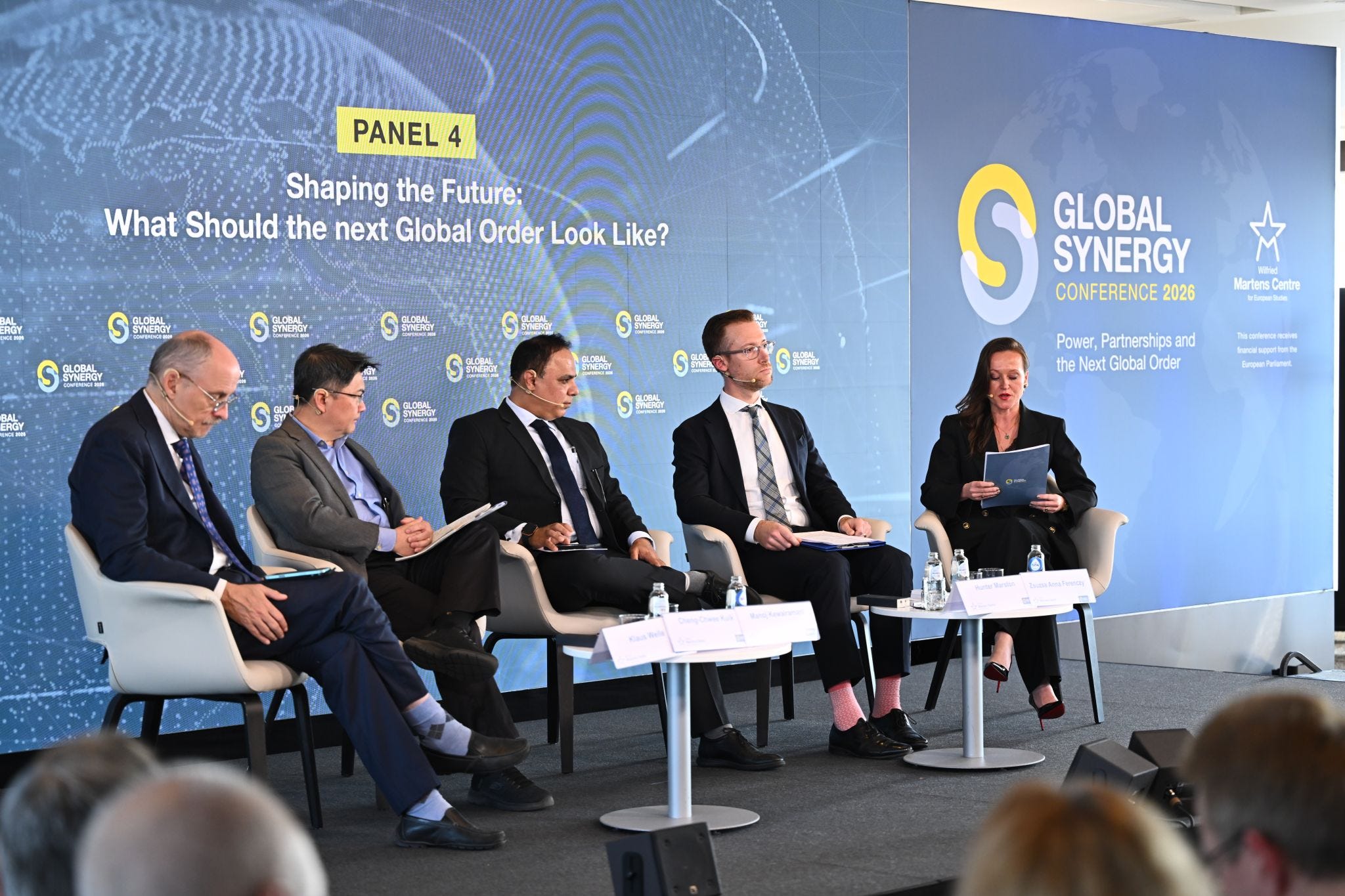
Although the eventual delivery was not exactly this, here’s what I tried to convey.
“This is a difficult question because it asks us to imagine the future. In doing so, I want to be both optimistic and idealistic, and not let the brutishness of the current environment, or even the inherent nature of international relations, undermine my imagination.
At the same time, ignoring the realities of the world—the enduring role of states, historical experiences of building order, and their limitations—would do a disservice to this inquiry.
So, after much thought, I am essentially adopting feasibility as the parameter to mediate between idealism and the reality of current times.
Before I get to what the contours of the order should/is likely to be, here is what I believe the next global order needs to contend with. I see three core tensions.
First, there is a tension among three forces:
Westphalian norms, which include state sovereignty, territorial integrity, non-intervention, and the legal equality of states;
the inherent desire of great powers to pursue absolute advantage, remain above rules that constrain them, shape spheres of influence or pursue empire, and
overreach based on a particular ideological zeitgeist about how global civilisation should be organised: be it liberal internationalism or the rejuvenation of nativism and even fascism today
Any sustainable order will have to balance and contend with these impulses.
Second, there is a tension between the ideas underpinning the liberal international order—open markets, free trade, global capitalism; democracy; human rights; rule of law; and collective security—and the realities of cultural and civilisational pluralism. We see this tension reflected in contemporary American foreign policy, for example, in the speeches by Vice President Vance and Secretary Rubio in Munich over the past two years.
In the morning, we heard about the European way of life and the search for certain common or shared values. I think that is a noble endeavour, and I do think that we can arrive at some common values. The challenge, of course, is how those common values materialise in tangible policy decisions within different countries. For example, as a classical liberal, to me, individual liberty is to me a shared value that we must all aspire toward. But all societies have tensions between the collective and the individual at different levels. There are no uniform templates of how these should be managed; so that is what I mean by some level of pluralism that any future order must contend with and account for.
Third, there is a tension between rhetoric or promise and delivery. An order is sustainable only when it aligns not merely with the aspirations of those who accede to it, but also with the actual distribution of power. And today, that distribution is uneven and volatile. In many ways, the world is unipolar, bipolar, multipolar, and non-polar all at once.
Meanwhile, the drivers of future power—compute, algorithms, data, network infrastructure, skilled talent—are evolving rapidly, while traditional sources of power—territory, population, natural resources—remain highly significant. Accounting for this dynamic mix is an enormous challenge for anyone seeking to build order.
What does this mean for building a new order?
First, it must be rules-based; otherwise, it isn’t truly an order. The concept of order requires a certain critical mass agreeing upon shared codes of behaviour. But these rules do not have to be those that once were. They will evolve.
Second, I believe the next order is likely to be unevenly multipolar, more plurilateral than multilateral, more regional than global, and more pluralistic than universalistic.
Third, my view is that this new order will likely be more state-centric and less individual-centric, meaning the flowering of civil society we saw after the Cold War will face profound challenges. Even private actors and transnational corporations will likely increasingly be subservient to the demands of the state and subject to the geopolitical priorities and whims of governments.
Will this order be stable and peaceful? Perhaps. Will it engender greater prosperity than the post-Cold War order? Unlikely.
I agree to much of your staments, and I hve been a strong admirer of how you bring Chinese dabetes into our unserstandings.
For this comment, I merely want to say that the structures of our current work "system" is jot simple. We need to recognise tha there is a small, totally militarized country that is upsetting the world system for its own, completely racist endeavour. Untill we are opely rectognizing this unfortunate influence on world positics, we will not be ableto fix it.